Senin, 08 November 2010


Fall is here and the calves are home from the mountain. Our calves have grown great this summer and are starting to really fill out. They will spend the winter here at the ranch on good grass/alfalfa hay. With the first green-up of spring they will go out on a meadow. They will stay there until they approach finish wieght and then they return home to more great hay and a custom grain ration until processing one month later. Our calves are raised like my Grandfather rasied his.....naturally. We like to think we know what are doing and have lots of repeat customers who agree. Please contact us anytime with questions or for more information. Thanks for your interest in Leaning H Livestock, home of Utah's Best Beef!

Senin, 13 September 2010


It's hard to believe that fall is almost here! Summer has passed so quickly. Our cattle have had a great summer and the rains have come at the right times to help keep the grass growing. Soon, we will be weaning our calves and bringing our cows home to graze on a meadow we lease. The calves are already getting most of their nutrition from grass and using less and less milk. When we bring them home, they will continue to grow as they convert quality hay into wonderful and healthy protien. It's always fun to have the calves home. They learn to look forward to us coming to feed and water. They gentle down quickly and enjoy being scratched behind an ear or across their backs. Our family and I hope you have had a great summer as well. We thank all of our valued customers for trusting us with providing them the meat that fills their freezers! We thank everyone who visits our blog! Feel free to get in touch with us if you ever have questions or need more information. Here's to a beautiful fall!

Selasa, 18 Mei 2010


Spring!!! After a cold winter, I sure look forward to the green grass of Spring. We can quit feeding hay and get the cows out on the mountain. But in order to do that we have to our annual branding. Hot branding cattle is a quick and tested way to identify cattle on the huge areas they graze most of the year. Just like a license plate on a car, it allows proof of ownership. We also vaccinate our cattle and tag at the same time. It is a lot of work but a lot of fun with family and friends helping. Many ranchers help each other in return for needed help on their own cattle. It is a western tradition that has passed through many generations. And we work quickly and as quietly as possibly to make the process as easy on our cows and calves as possible. Just like a pierced ear that a lot of women get done when they are girls, It looks worse than it is. Our Leaning H Brand means that the calf that wears it is high quality and well cared for. Thanks to both our parents for the great help. Couldn't do it without ya! With the cattle branded and out on grass, we look forward to trips to the mountain to check water, mend fence and supply salt and mineral for our cattle. Another cycle of the lifestyle we love so much. Hope ya enjoyed us taking ya along!

Kamis, 08 April 2010

Google Earth helps discover rare hominid ancestor in South Africa

Today, scientists announced a new hominid fossil discovery in the Cradle of Humankind World Heritage Site in South Africa. The discovery is one of the most significant palaeoanthropological discoveries in recent times, revealing at least two partial hominid skeletons in remarkable condition, dating to between 1.78 and 1.95 million years. We are especially excited because Google Earth played a role in its discovery.


So how did this come about? Back in March 2008, Professor Lee Berger from Witswatersrand University in Johannesburg started to use Google Earth to map various known caves and fossil deposits identified by him and his colleagues over the past several decades, as it seemed the ideal platform by which to share information with other scientists. In addition, he also used Google Earth to locate new fossil deposits by learning to identify what cave sites looked like in satellite images.


At the beginning of this project, there were approximately 130 known cave sites in the region and around 20 fossil deposits. With the help of the navigation facility and high-resolution satellite imagery in Google Earth, Professor Berger went on to find almost 500 previously unidentified caves and fossil sites, even though the area is one of the most explored in Africa. One of these fossil sites yielded the remarkable discovery of a new species, Australopithecus sediba. This species was an upright walker that shared many physical traits with the earliest known species of the genus homo — and its introduction into the fossil record might answer some key questions about our earliest ancestry in Africa.

We’re absolutely thrilled about this announcement, and delighted that our free mapping tools such as Google Earth and Google Maps continue to enable both individuals and distinguished scientists to explore and learn about their world. With these tools, places both foreign and familiar can be explored with the click of a mouse, allowing for new understandings of geography, topology, urbanism, development, architecture and the environment. Our efforts to organize the world’s geographic information are ongoing — but at the end of the day, seeing the way these tools are put to use is what most inspires us.


Rabu, 07 April 2010

Google Code Jam 2010 registration now open

Let’s say that you have x different stocks, and the plots of their prices over time. You want to print them in newspaper, printing multiple plots on the same chart to save space. But here’s the catch: no two plots on the same chart can overlap, lest the readers be confused. Look at the plots and figure out the smallest number of charts required.

Looking for a challenge like the riddle above? And I mean an exciting brain-twisting and turning kind of challenge. I mean competing with fellow coders from around the world for top bragging rights kind of challenge.

Since 2003, we’ve brought you our annual Google Code Jam — a competition in which professional and student programmers from all around the world solve tough algorithmic challenges in a limited amount of time. Last year’s 23,000 contestants vied for the title of Google Code Jam champion. After five rounds and some furious typing, China’s Lou Tiancheng (code-named ACRush) was named champion.

Sound like the challenge for you? Well registration is now open. And you can try your hand at problems from previous competitions and get up to speed with the rules. We recommend that you practice hard — Code Jam is not for the weak of heart! And, this year we’ve decided to take the show on the road — for the very first time, the final competition will take place in Google’s Dublin office.

The qualification round starts on May 7, 2010 and after four rounds of online competition, the top 25 competitors will be flown to Dublin to match wits for the $5,000 first prize — and, of course, the title of Code Jam champion!

P.S. Have you solved our “Stock Charts” problem yet? Test your solution on the Code Jam website.

Mission Blue: filling in the blanks...

Last year, we launched Ocean in Google Earth, expanding the scope of Earth to include 3D maps of the world’s oceans and videos, photos and narrative from the world’s leading scientists and media sources to bring them to life. We worked with more than 100 partners to begin to fill in the “blue” part of the planet, adding hundreds of placemarks in more than 20 ocean layers. Since then, we’ve added hundreds of new posts to the Ocean layer with the help of Sylvia Earle’s Mission Blue Foundation and dozens of committed individuals around the world. The posts come from a diverse range of partners including National Geographic, independent videographers and dive enthusiasts, government organizations like the National Oceanographic and Atmospheric Administration (NOAA) and international organizations like the International Union for Conservation of Nature (IUCN).

Today, the layer will become part of the default set of annotations seen by all Earth users. Although a humble step given the dearth of information available about these vast expanses of geography, we are happy to take one more step to make the oceans a first-class part of Google Earth and to give them at least a starter portion of the thick soup of photos and places that describe the land part of the planet. One of the greatest things about Earth is that it allows everyone to see and experience the fullness of their planet, from revisiting places they know well to venturing out to formerly unknown mountain peaks, desert vistas, and increasingly, the blue heart of life on Earth. As Sylvia has said of the Ocean on many occasions, “With knowing comes caring, and with caring there’s hope.”

Soon after last year’s launch, Sylvia asked attendees at the TED conference to help her realize a wish: to create a series of marine protected areas she calls Hope Spots. Sylvia and a group of influential thinkers are now on a Mission Blue Voyage to the Galapagos Islands to brainstorm how they might best achieve better ocean protection. You can follow them on their journey by visiting the the Mission Blue Foundation website and on Twitter at @MissionBlue. There you can learn more about the launch of their Hope Spots initiative and visit all 18 of these spots using the Google Earth plugin.


We’ve also created a narrated tour featured in the Ocean Showcase to introduce you to eight of the regions proposed for protection: the Eastern Pacific Seascape including the Galapagos Islands, the Gulf of California, the Mesoamerican Reef in the Caribbean including Belize, the Sargasso Sea in the mid-Atlantic, the Chagos Archipelago in the Indian Ocean, the Coral Triangle, the Ross Sea in the Antarctic and Gakkel Ridge in the Arctic.

We’d also like to take a moment to thank the partners who have helped us improve our 3D canvas of the world’s oceans in the past year: NOAA (global coverage), MBARI (Monterey Bay Canyon), The California State University at Monterey Bay (California Coast), The Center for Coastal and Ocean Mapping - Joint Hydrographic Center at the University of New Hampshire (Arctic) and The Living Oceans Society (British Columbia and Canada).

As Earth Day approaches, we hope you’ll take a little time to explore the planet, including the blue part.

It takes one to show one: Getting a business off the ground with AdWords

This is the first in a series of posts about entrepreneurship and the resources that can help small businesses succeed. In the coming weeks, we’ll share the inspirational stories of real people — just like you — who’ve used various Google tools to start up, maintain and grow their businesses. To kick off the series, we’re starting with a post about a small business owner’s experience with Google AdWords — the program that helped level the marketing field for companies of all sizes. -Ed.

Small businesses are especially close to my heart. When he retired from teaching, my father ran a small art company in Maine, and I saw firsthand how fulfilling — and how difficult — it was for him to realize his dream of running his own business. Unfortunately, his business closed its doors after just a few years. His key challenge: attracting qualified customers.

Many new businesses face similar challenges, but the power of technology can help business owners find the customers they need. Whether you’re a fledgling entrepreneur trying to turn your passion into a profit or an established enterprise trying to get to the next level, Internet tools like Google AdWords are the key to being there when customers come looking for you online.

To show what's possible, we invited 53-year-old Jay Berkowitz to share his experience creating a business and using AdWords to help it flourish. Here's what Jay has to say:
Like most first-time parents, my life completely changed when my daughter Hillary was born in 1993. My wife Janet and I decided that one of us should stay at home to care for her while the other continued working full time. Janet kept her engineering job, and I ended up quitting my job as a Wall Street bond analyst to become Mr. Mom.

Later, when Hillary started school, I had more free time. It seemed like the perfect chance to do something I’d always dreamed of: launch my own business and work for myself. I started selling themed plates and lunchboxes at New York City street fairs. Then in 2001, eight-year-old Hillary showed me (her non-tech-savvy dad) how to turn on a computer. That was the beginning of taking the business online, and realizing a whole new world of possibility. Janet and I worked together to build a website, PlatesPlus4Kids.com, and we started advertising online with Google AdWords. Soon, my little project became a full-fledged venture.

By advertising on the Internet, I was able to reach interested customers not only in my area, but all over the country. More and more people found my store through online searches. In no time, I had so many orders that I could no longer keep my inventory of themed cups, plates and lunchboxes on the kitchen table. The stock moved to the den, then the basement, and finally to a warehouse 20 minutes from our house in Little Neck, New York. Over the years, I've also expanded my product line and now offer children’s backpacks, umbrellas, flatware, snack containers and sandwich boxes. What started as a hobby now brings in about $500,000 in sales annually.

I only pay when people click on my ad and go to my website, so the cost of marketing is within my means. I increase the budget during the back-to-school season and the holidays (my peak periods) so my ads show above the search results during those times. I've also noticed that customers seem to be in a shopping mood on Mondays and Tuesdays, so I sometimes increase my budget on those days to make sure my ads show up more. Depending on trends, I create new ads to promote different characters and new inventory. For example, now that Yo Gabba Gabba is popular and baseball season is starting, I'm making adjustments so that those phrases combined with words like “dishes,” “placemats” and “cups” trigger my ads. And of course, I have ads that mention items with princesses and superheroes — those are top sellers year-round.


What's really great is that even though my business has expanded over the past seven years, it's still a small family company. Two people work for me at the warehouse, but I work from home. Janet takes pictures of the products and works on the website on the weekends. I've had the freedom to be a hands-on parent to Hillary and the privilege of helping other parents connect with their kids through my store. Certain celebrity parents have found me through my AdWords ads and bought items for their kids.

I consider myself a pretty ordinary guy. When I started PlatesPlus for Kids, I had no idea it would become what it is today. It's heartening to know that by following your gut and putting in a lot of hard work, you can find a fulfilling second career. Or maybe a first one.

Jay, Hillary and Janet

Kamis, 01 April 2010

Model Your Town Competition: Cast your vote!

The first-ever Google Model Your Town Competition has entered the public voting phase. It’s now up to you to help decide which of the five finalist towns should be the overall winner. Cast your vote before May 1.
  • Barranco (Lima, Peru)
  • Braunschweig (Niedersachsen, Germany)
  • Donostia - San Sebastián (Gipuzkoa, Spain)
  • Dursley (Gloucestershire, United Kingdom)
  • West Palm Beach (Florida, United States)


These five teams used Google SketchUp and Google Building Maker to create beautifully detailed 3D models of their communities — and now they’re viewable in Google Earth by everyone in the world. To see all of the towns who entered the competition, check out the Google 3D Warehouse collection.

The winning town will receive an event hosted by Google in their honor, US $10,000 for their local schools and more. Don’t forget to vote by May 1, and we’ll announce the winning town by May 15.

And if you’re interested in learning how you can model your town, check out our Your World in 3D website for examples and other tools to help you get started.

A different kind of company name

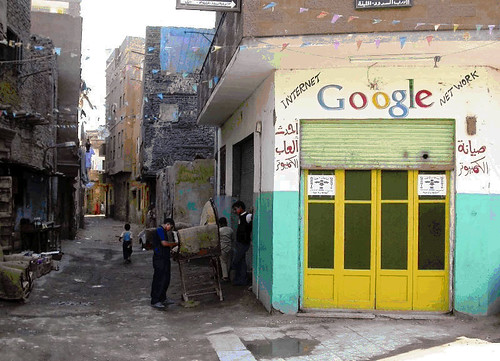
Early last month the mayor of Topeka, Kansas stunned the world by announcing that his city was changing its name to Google. We’ve been wondering ever since how best to honor that moving gesture. Today we are pleased to announce that as of 1AM (Central Daylight Time) April 1st, Google has officially changed our name to Topeka.


We didn’t reach this decision lightly; after all, we had a fair amount of brand equity tied up in our old name. But the more we surfed around (the former) Topeka’s municipal website, the more kinship we felt with this fine city at the edge of the Great Plains.

In fact, Topeka Google Mayor Bill Bunten expressed it best: “Don’t be fooled. Even Google recognizes that all roads lead to Kansas, not just yellow brick ones.”

For 150 years, its fortuitous location at the confluence of the Kansas River and the Oregon Trail has made the city formerly known as Topeka a key jumping-off point to the new world of the West, just as for 150 months the company formerly known as Google has been a key jumping-off point to the new world of the web. When in 1858 a crucial bridge built across the Kansas River was destroyed by flooding mere months later, it was promptly rebuilt — and we too are accustomed to releasing 2.0 versions of software after stormy feedback on our ‘beta’ releases. And just as the town's nickname is "Top City," and the word “topeka” itself derives from a term used by the Kansa and Ioway tribes to refer to “a good place to dig for potatoes,” we’d like to think that our website is one of the web's top places to dig for information.

In the early 20th century, the former Topeka enjoyed a remarkable run of political prominence, gracing the nation with Margaret Hill McCarter, the first woman to address a national political convention (1920, Republican); Charles Curtis, the only Native American ever to serve as vice president (’29 to ‘33, under Herbert Hoover); Carrie Nation, leader of the old temperance movement (and wielder of American history’s most famous hatchet); and, most important, Alfred E. Neuman, arguably the most influential figure to an entire generation of Americans. We couldn’t be happier to add our own chapter to this storied history.

A change this dramatic won’t happen without consequences, perhaps even some disruptions. Here are a few of the thorny issues that we hope everyone in the broader Topeka community will bear in mind as we begin one of the most important transitions in our company’s history:
  • Correspondence to both our corporate headquarters and offices around the world should now be addressed to Topeka Inc., but otherwise can be addressed normally.
  • Google employees once known as “Googlers” should now be referred to as either “Topekers” or “Topekans,” depending on the result of a board meeting that’s ongoing at this hour. Whatever the outcome, the conclusion is clear: we aren’t in Google anymore.
  • Our new product names will take some getting used to. For instance, we’ll have to assure users of Topeka News and Topeka Maps that these services will continue to offer news and local information from across the globe. Topeka Talk, similarly, is an instant messaging product, not, say, a folksy midwestern morning show. And Project Virgle, our co-venture with Richard Branson and Virgin to launch the first permanent human colony on Mars, will henceforth be known as Project Vireka.
  • We don’t really know what to tell Oliver Google Kai’s parents, except that, if you ask us, Oliver Topeka Kai would be a charming name for their little boy.
  • As our lawyers remind us, branded product names can achieve such popularity as to risk losing their trademark status (see cellophane, zippers, trampolines, et al). So we hope all of you will do your best to remember our new name’s proper usage:
Finally, we want to be clear that this initiative is a one-shot deal that will have no bearing on which municipalities are chosen to participate in our experimental ultra-high-speed broadband project, to which Google, Kansas has been just one of many communities to apply.

Rabu, 31 Maret 2010

Introducing Google Ad Innovations

The principle behind the advertising products we build at Google is simple: ads are information. But the type of information that ads provide is getting more varied and inventive all the time, and as a result ads are getting more interesting, social and useful.

As advertising evolves, we want to build the tools that make it possible for marketers to connect with customers in meaningful, creative ways. We’ve found that the best way to do that is to focus on the user, test new approaches regularly and listen closely to the feedback of the advertisers using our products. To work closely with advertisers on what comes next, today we’ve launched Google Ad Innovations, where we’ll show you some of our latest ideas around advertising technologies and get your feedback.

One of the new features we’re showcasing is a set of AdWords reports, launched last week, called Search Funnels. These reports can help an advertiser understand whether there are keywords in her account that are helping to drive sales at a later date. At Google Ad Innovations, you can read more about this feature, watch a video walking you through how it works and send us your ideas on how to improve it.

If you’re interested in the future of advertising with Google, pay Ad Innovations a visit — we’ll regularly add tools and features to the site, and we hope you’ll check them out!

Selasa, 30 Maret 2010

Our stand for digital due process

The year was 1986. A gallon of gas cost 89 cents, Paul Simon’s Graceland won the Grammy for album of the year, and the federal Electronic Communications Privacy Act (ECPA), which governs how law enforcement can access electronic data, was signed into law.

A lot has changed since 1986. Gas is now measured in dollars and Taylor Swift (born 1989) won album of the year. All the while, technology has moved at record pace. But ECPA has stayed the same. Originally designed to protect us from unwarranted government intrusion while ensuring that law enforcement had the tools necessary to protect public safety, it was written long before most people had heard of email, cell phones or the “cloud” — the term used for programs helping people store personal data like photos and documents online. As a result, ECPA has become outdated.

This is why we’re proud to help establish Digital Due Process, a coalition of technology companies, civil rights organizations and academics seeking to update ECPA to provide privacy protections to new and emerging technologies.

Specifically, we want to modernize ECPA in four ways:
  • Better protect your data stored online: The government must first get a search warrant before obtaining any private communications or documents stored online;
  • Better protect your location privacy: The government must first get a search warrant before it can track the location of your cell phone or other mobile communications device;
  • Better protect against monitoring of when and with whom you communicate: The government must demonstrate to a court that the data it seeks is relevant and material to a criminal investigation before monitoring when and with whom you communicate using email, instant messaging, text messaging, the telephone, etc.; and
  • Better protect against bulk data requests: The government must demonstrate to a court that the information it seeks is needed for a criminal investigation before it can obtain data about an entire class of users.
We also created this video to help explain ECPA and why it needs updating:


You can read more about our proposal at our coalition website. In the coming months, we’ll meet with lawmakers, law enforcement officials and others to help build support for modernizing the law.

1986 was a good year, but it’s time our laws catch up with how we live our lives today.

Around the world in 25 iGoogle themes...

One way we love to help you make iGoogle your own is with our artist and designer themes — ranging from food and fashion to games and comics. Today, we’re excited to announce a set of new themes, tailored to the world traveler in all of us. These new themes, focused on destinations all over the globe, allow you to experience beautiful landscapes, historic monuments, stunning beaches, iconic cities and other picturesque sites — right from your homepage.

To bring you this imagery, we've partnered with a few leading organizations including National Geographic Society and LIFE, who photograph some of the most breathtaking destinations on earth. Lonely Planet, UNESCO and visiteurope.com have also shared a selection of incredible images.

Here’s a quick preview of some of what you’ll find:

Hopefully, you’re as eager to try out these new themes as we are. Whether these themes remind you of one of your favorite places or allow you to experience a global destination on your homepage, we hope you enjoy them. Bon voyage!

Senin, 29 Maret 2010

Improved chat for iGoogle and orkut

Have you ever wanted to quickly send a file to a friend who's online? Now you can share pictures, documents and other files directly with your friends while chatting in iGoogle and orkut, without having to switch to email to send the file as an attachment. File transfer works directly in the browser so you don't need to install anything. Just start a conversation with a friend and click “Send a file...” in the “Actions” menu. After you select a file, your friend will be asked if they want to accept the transfer. You can learn more on the Google Talkabout Blog.


You might have noticed that we recently gave iGoogle and orkut chat a face lift. Several tools now have a new home at the top of the chat window. From the new toolbar, you can click the blue camera and phone icons to start video and voice chats with your friends or the group chat icon to add additional friends to a text chat. If you've never used video or voice chat before, all you need is a webcam and microphone attached to your computer and a small plugin application available for free at www.google.com/chat/video.

We're working to bring file transfer and the new toolbar to Gmail too. In the meantime, you can continue to access voice, video and group chat in Gmail from the “Video and More” menu in a chat window.

Jumat, 26 Maret 2010

This week in search 3/26/10

This is one of a regular series of posts on search experience updates. Look for the label This week in search and subscribe to the series. - Ed.

This week we're highlighting a few recent internationalization projects, as well as some improvements to the way you conduct your searches. Here's a summary.

Improved Google Suggest interface & internationalization
In 2008, we launched Google Suggest to help you formulate queries, reduce spelling errors and save keystrokes. Since then, we've made a number of visual changes to Suggest for English-speaking users of google.com, including:
  • Boldface search suggestions to make it faster to scan the list of suggestions and find what you're looking for
  • Adding the "Google Search" and "I'm Feeling Lucky" buttons to the box so they're still accessible even when the Suggest box is open
  • Removing the result counts, which previewed the number of results for each search, to simplify your experience
Given the popularity of these changes, we've just rolled them out in 50 languages across all 170 domains where Google Suggest is available. No matter where you are, we hope you find that Suggest is now faster and easier to use.


Real-time search in more languages
As you've probably noticed, our search results page for Google.com in English now includes a dynamic stream of real-time content from popular sites like Facebook, FriendFeed, Jaiku, Identi.ca, MySpace and Twitter. Since we launched real-time search, we've continued to make significant improvements in the relevance technology. As of today, real-time search is available in 40 languages. Now when you're visiting family in Puerto Rico, or if you speak German and live in Switzerland, you'll be able to see live updates from people on these popular sites as well as news headlines and blog posts published just seconds before.

Refinements for local searches
Whether you're looking for info close to home or while you're traveling, it's now easier to find things to do in the cities you're searching for on Google. Now when you search for a city name, we'll show you popular query refinements for places in those cities. We've found that people like to explore several places during a trip, so when we show one point of interest, we'll also show you related points of interest. For instance, if you're looking for food or a place to stay, you'll also see some of the top category and neighborhood refinements to help you choose a place. This new feature will be rolling out over the next couple days for 200 U.S. cities, and in the coming weeks we'll expand coverage to more cities internationally.

Example searches: [maui], [pikes place market] and [restaurants berkeley california]


Lists in Bookmarks
This week we introduced lists in Google Bookmarks, an experimental feature that helps you easily share sites with friends. With lists, you can sort and categorize your Google Bookmarks or starred search results. Once you've created a list, you can share it with specific friends or make it publicly visible and searchable (lists are private by default). Based on the content of your list, we'll also generate suggestions for related links, so you can discover more helpful info related to a list you're already building. We’re launching lists as an experimental feature, and it is available at www.google.com/bookmarks or by clicking the "Starred results" link on your search results page. From there, select the links you want to share and click “Copy to list.”

Example lists: [welcome to lists] and [seattle sites]


Thanks for reading, and stay tuned for more search improvements next week.

Tomorrow night, turn off your lights!

Tomorrow from 8:30 to 9:30pm local time, hundreds of millions of people around the world will switch off their lights and participate in Earth Hour, the largest climate awareness event ever held. As climate change will effect people on every continent, we think a united, global call for action to address the problem is needed.


At Google we’re working hard to be part of the solution for the climate crisis. A first step was pledging to be a carbon neutral company. Our web-based services run in some of the world’s most efficient data centers, we deploy renewable energy where viable, and we buy high-quality carbon offsets to address the emissions we can’t otherwise eliminate.

Even with these efforts, however, there remains an urgent need for clean, affordable electricity. To that end we have a team of engineers working to develop technology breakthroughs that will help make carbon-free electricity an economically viable alternative to electricity from coal.

We’re also putting our experience with organizing information to work, so we can enable others to do projects in the sustainable space. We recently announced, for example, Earth Engine, a computational platform that enables global-scale monitoring and measurement of changes in the Earth’s forests. And we’re working with our peers through Climate Savers Computing to cut the power used by computers in half.

We also want to help you achieve your personal energy reduction targets. Most people don’t know their own direct energy footprint, so we launched Google PowerMeter to give detailed, near real-time information about home energy usage. We also like to encourage everyone to set their computer’s power management to avoid wasting electricity when it’s not being used.

It’s tools like Google PowerMeter that my parents wish they had years ago when I was a teenager and living under their roof. They were often exasperated to find the lights on in rooms I’d just left, and it took years for them to convince me that I could choose something to eat without standing in front of the fridge with the door wide open. The point is, I had to learn to become a steward of the environment. We can help many more people take steps toward better care of the environment, and make that learning curve easier to climb.

Turning off the lights won’t solve the climate crisis, but it’s a start. Earth Hour gives individuals a simple, meaningful way to participate in a global call for change. As U.N. Secretary-General Ban Ki-moon stated, “Earth Hour is a way for the citizens of the world to send a clear message — they want action on climate change.”

So I hope you’ll gather your friends and family and join me, and hundreds of millions of others, in turning off the lights. And please include the light in the fridge.

Google Apps highlights — 3/26/2010

This is part of a regular series of Google Apps updates that we post every couple of weeks. Look for the label "Google Apps highlights" and subscribe to the series. - Ed.

We've been busy over the last couple weeks launching updates to make Google Apps more useful, whether you use Google Apps at work, at school or at home.

Smart Rescheduler Lab in Google Calendar
If you’ve ever tried to schedule time with a group of people who have packed agendas, you know how hard it can be to find a good meeting time that works for everyone. With the Smart Rescheduler, Google Calendar can sift through the details for you. When you need to reschedule an appointment, Smart Rescheduler quickly compares people’s calendars and ranks potential meeting times based on criteria like attendees, schedule complexity, conference rooms, and time zones. You can enable Smart Rescheduler by going to “Labs” under “Settings” in Google Calendar.


Suspicious account activity alerts
To help keep Gmail users and the data in their accounts safer, on Wednesday we launched a new security feature to alert you if our systems detect suspicious activity in your account. When something unusual is identified, you’ll see a warning notification near the top of your inbox. You can choose to view a log of recent activity, and if it looks like your account has been compromised, you can change your password immediately. (And while we’re on the topic of security, we encourage you to brush up on our tips to keep your account safer.) We know that security is also a top priority for businesses and schools, and we plan to bring this feature to Google Apps customers once we have gathered and incorporated their feedback.


Contact delegation
Businesses using Google Apps can use a feature called email delegation, which lets employees appoint delegates who are allowed to read, send and manage email on their behalf. For example, this allows executive assistants to handle email for their managers. As of last Monday, delegates can also access and manage contacts. Now, a delegate can pick contacts from the manager’s contact list when composing a message on behalf of the manager, and keep the manager’s contacts up-to-date.

Google Apps Migration for Microsoft® Exchange
Millions of companies and schools have switched to Google Apps, and we hope to help millions more “go Google” in the near future. To make the transition as smooth as possible, we’ve released Google Apps Migration for Microsoft® Exchange, a server-to-server migration utility that brings email, contacts and calendar data from a legacy Microsoft® Exchange system to Google Apps. This makes the transition more seamless for employees, faculty and students. When they sign in to Google Apps, they’ll see the messages, contact information and calendar appointments from the old system right in Gmail and Google Calendar.

Who’s gone Google?
The number of businesses and other organizations using Google Apps continues to shoot up, and we hit another big milestone by crossing the 25 million user mark. Among those are the 7,000 employees at Konica Minolta, who are using Google Apps to help the company move fast and be more productive.

We’re excited to welcome another string of schools and universities too, including the University of Arkansas at Little Rock and the College of William and Mary. Marshall University has a particularly great story: their technology group challenged themselves to deploy Google Apps to over 50,000 students in less than 24 hours – quite a feat when it typically takes large organizations months or even years to make major technology changes. We hope Marshall’s nimble approach inspires others to make the switch!

I hope you're enjoying the latest round of new features, whether you're using Google Apps with friends and family, with colleagues or with classmates. And don’t forget, you can always check the Google Apps Blog for more details and the latest news in this area.

Next steps for our experimental fiber network

Since we announced our plans to build experimental, ultra high-speed broadband networks, the response from communities and individuals has been tremendous and creative. With just a few hours left before our submission deadline, we've received more than 600 community responses to our request for information (RFI), and more than 190,000 responses from individuals (we'll post an update with the final numbers later tonight). We've seen cities rename themselves, great YouTube videos, public rallies and hundreds of grassroots Facebook groups come to life, all with the goal of bringing ultra high-speed broadband to their communities.


We're thrilled to see this kind of excitement, and we want to humbly thank each and every community and individual for taking the time to participate. This enthusiasm is much bigger than Google and our experimental network. If one message has come through loud and clear, it's this: people across the country are hungry for better and faster Internet access.

So what's next? Over the coming months, we'll be reviewing the responses to determine where to build. As we narrow down our choices, we'll be conducting site visits, meeting with local officials and consulting with third-party organizations. Based on a rigorous review of the data, we will announce our target community or communities by the end of the year.

Of course, we're not going to be able to build in every interested community — our plan is to reach a total of at least 50,000 and potentially up to 500,000 people with this experiment. Wherever we decide to build, we hope to learn lessons that will help improve Internet access everywhere. After all, you shouldn't have to jump into frozen lakes and shark tanks to get ultra high-speed broadband.

Thanks again to all the communities and citizens that submitted a response. We feel the love, and we're honored by your interest.

Update at 5:26pm: The response deadline has now passed. We've received more than 1,100 community responses and more than 194,000 responses from individuals. This map displays where the responses were concentrated as of 1:30pm PT. Each small dot represents a government response, and each large dot represents locations where more than 1,000 residents submitted a nomination. We plan to share a complete list of government responses and an updated map soon.


Update April 15: We've had a chance to parse the list of government response to eliminate additional spam and redundancy. You can find the complete list of government responses on our request for information website. We have also updated the map to reflect the complete list of submissions.

Rabu, 24 Maret 2010

Display advertising: towards creativity without limits

This is the second post in our series on the future of display advertising. Today, Neal Mohan looks at how new technology can power creativity in the years ahead - Ed.

Imagine you own a popular coffee chain in Denver that you want to promote. On Monday afternoon, it’s warm and 80 degrees in the city. You run a display ad campaign online that offers Denverites a discount coupon for an iced cold latte, with a searchable map embedded in the ad to show local branches, and a real-time feed from people who have tweeted publicly about your newest flavor. That evening, a cold front rolls over the Rockies. Your ad automatically and dynamically adjusts to present a photo of a hot, steaming cup of hot chocolate in front of a warm fireplace, together with a home delivery number and an offer of free marshmallows.

Creative? Absolutely. Impossible? Hardly. You can do this today using technology from Teracent that we’re working to roll out for our clients who advertise on the Google Content Network or who use DoubleClick Rich Media.

There’s no doubt that advertisers today are increasingly seeking to run campaigns that are highly measurable and relevant to users. That’s one of the benefits of advertising on the Internet. But great ad campaigns are about more than clicks or numbers. The best campaigns are so memorable and effective because they make an emotional bond with us. The very best can engage us, move us and make us feel a connection with the brand that’s being promoted. That’s the real creative genius of advertising.

We traditionally think of TV as the most creative advertising media. But display advertising has the promise of a couple of things that even TV doesn't have — the ability to dynamically customize ads in infinite ways and the opportunity to enable a true two-way interaction and dialogue with users.

Here are some examples of how creative ads have been used to drive engagement and deliver great results:
  • An award-winning rich media ad that was created by Euro RSCG for the new Volvo XC60. In addition to an interactive game, photos and gallery, it incorporated a Twitter feed from the New York Auto show. In just three days, the campaign garnered 170 million impressions, 50,000 clicks and 17,000 hours of brand engagement. No other type of advertising format could have come close in driving this type of conversation with a brand's potential customers.
  • A great campaign for Harley Davidson, created by the agency Overdrive. This ad functions almost like a website — with interactive video, Twitter and Facebook Share functionality, as it invites people to send a "Tribute to the Troops" for Veteran's Day. Over 280,000 people clicked to watch the video embedded in the ads and more than 18,000 Tributes were sent to troops from this campaign.

Some in our industry have asked why we aren’t seeing more creative display ad campaigns like these. In our view, it’s definitely not because of a lack of creativity or an unwillingness to experiment. The problem to date has been the lack of tools and technologies necessary to do this at scale across the Internet.

It takes hard work to create, serve and measure the impact of these ads. Under the hood, there’s a lot of technology that needs to come together for them to work seamlessly. Take the Harley Davidson ad: It contains dozens of complex creative elements, integrations with various technologies like Flash, numerous APIs, Twitter and Facebook, and multiple parties involved in its creation and delivery — from the creative agency, to teams at Google, through to the ad operations teams at the publisher. You could spend hundreds or thousands of hours building out creative concepts and ads like this, but ultimately only run them on a few sites because the customization takes so much time to implement across the web.

We believe that technology, by streamlining and eliminating some of the hard work involved, and by offering new creative possibilities, can be a great enabler of more creative ads.

What if it were seamless to serve and run highly creative ad units — not just on one site, but on thousands of sites, and also in videos and on mobile phones? What if it were simpler to incorporate social features in the ad creative itself — such as letting people endorse and spread particular ads or campaigns to their friends? What if you could serve video ads that included simple tools in the ad creative itself that allowed users to easily make their own mashups of your ad, and post and share them with friends?

And what if you could make a few different creative elements for an ad, and then have them dynamically chosen, depending on factors like where the ad’s shown, product availability, time of day and any other variable you choose — just like the coffee ad I mentioned at the start? That way, agencies and advertisers would be able to spend their time building out their creative concepts and ads, and technology can multiply the impact by running it on thousands of sites with millions of variations for every website and user.

Technology is evolving rapidly and will help facilitate all of this in the months and years ahead. What about imagining what might be possible on your phone in a few years? Let’s say you're walking down the street, using an augmented reality app on your mobile phone to see what's interesting around you. In your viewfinder, you see a billboard for a great product — basketball shoes. Using image recognition, the app could recognize that it's a billboard for a particular shoe brand, show an expandable ad for that brand, let you choose to watch a video of one of their shoes in action, display all the nearest stores on an accompanying map, and include a way for you to order a shoe and pick it up on your way home from work.

That’s just one example of what one day will be possible in the world of display advertising. It’s the goal of our display advertising efforts to produce the tools and technologies to allow for this type of unbridled creativity at a grand scale.

Collaborative bookmarking with lists

Earlier this month we added stars in search so that you can easily mark and rediscover your favorite websites. Today we’re debuting lists in Google Bookmarks, an experimental new feature that helps you easily share those sites with friends.

Bookmarks are a great way to keep track of your favorite content across the web and we want to help you share them with your friends. To use lists, visit Google Bookmarks at google.com/bookmarks or by clicking “Manage all” in your Google Toolbar. From there, select the links you want to share and click “Copy to list.” Lists are private by default, but once you’ve created one you can share it with specific friends or even publish it to the web. For example, if a friend of yours is visiting Seattle for the first time and you have some local attractions bookmarked, you might want to create a new list for “Seattle attractions” and share it with your friend.


Sharing lists can help you collaborate with your friends on common interests or activities. Let’s say you’re planning a group trip to Paris. With a list, everyone can contribute useful links and resources, such as packing lists, hotel links, flight information and attractions. You could also create lists for your favorite hobbies, and then share them with friends who share your interests. Lists dynamically generate previews for many pages so you can get a sense of the site before clicking.

Lists also help you discover new web content. For example, once you’ve created your list of favorite Seattle attractions, Google will algorithmically analyze your list to identify other potentially relevant links, such as the Seattle Aquarium. Similarly, when we detect that a list is relevant to a specific region, we provide a map of those places and relevant info for each place, such as addresses, hours and reviews.


We’re launching lists as an experimental feature so that we can quickly test it out and get feedback. Visit Google Bookmarks on google.com in English to try it out and let us know what you think. You can also learn more about lists in our Help Center.

Selasa, 23 Maret 2010

European Court of Justice rules in Google’s favour

Google aims to provide as much information as possible to users so that they can make informed decisions. For this reason, we have been awaiting a series of decisions by the European Court of Justice that explore the extent to which trade mark rights can be used to restrict information available to users. The first of those decisions was delivered today.

The question before the court was whether advertisers should be allowed to choose keywords freely when reaching out to users on the Internet. In other words, if advertisers are allowed to show advertisements when another company's brand name is entered as a search query.

Trade marks are part of our daily life and culture, helping us to identify the products and services that we may be looking for. They are key for companies to market and advertise their products and services. But trade mark rights are not absolute.

We believe that user interest is best served by maximizing the choice of keywords, ensuring relevant and informative advertising for a wide variety of different contexts. For instance, if a user is searching for information about a particular car, he or she will want more than just that car’s website. They might be looking for different dealers that sell that car, second hand cars, reviews about the car or looking for information about other cars in the same category.

And, contrary to what some are intimating, this case is not about us arguing for a right to advertise counterfeit goods. We have strict policies that forbid the advertising of counterfeit goods; it's a bad user experience. We work collaboratively with brand owners to better identify and deal with counterfeiters.

Some companies want to limit choice for users by extending trade mark law to encompass the use of keywords in online advertising. Ultimately they want to be able to exercise greater control over the infomation available to users by preventing other companies from advertising when a user enters their trade mark as a search query. In other words, controlling and restricting the amount of information that users may see in response to their searches.

Today, the Court confirmed that Google has not infringed trade mark law by allowing advertisers to bid for keywords corresponding to their competitors’ trade marks. It also confirmed that European law that protects internet hosting services applies to Google’s AdWords advertising system. This is important because it is a fundamental principle behind the free flow of information over the internet.

Our guiding principle has always been that advertising should benefit users, and our aim is to ensure that ads are relevant and useful. We will study the decision as we move forward in order to make sure that we continue to deliver advertising that is perceived as both valuable and relevant by our users.

Senin, 22 Maret 2010

A new approach to China: an update

On January 12, we announced on this blog that Google and more than twenty other U.S. companies had been the victims of a sophisticated cyber attack originating from China, and that during our investigation into these attacks we had uncovered evidence to suggest that the Gmail accounts of dozens of human rights activists connected with China were being routinely accessed by third parties, most likely via phishing scams or malware placed on their computers. We also made clear that these attacks and the surveillance they uncovered—combined with attempts over the last year to further limit free speech on the web in China including the persistent blocking of websites such as Facebook, Twitter, YouTube, Google Docs and Blogger—had led us to conclude that we could no longer continue censoring our results on Google.cn.

So earlier today we stopped censoring our search services—Google Search, Google News, and Google Images—on Google.cn. Users visiting Google.cn are now being redirected to Google.com.hk, where we are offering uncensored search in simplified Chinese, specifically designed for users in mainland China and delivered via our servers in Hong Kong. Users in Hong Kong will continue to receive their existing uncensored, traditional Chinese service, also from Google.com.hk. Due to the increased load on our Hong Kong servers and the complicated nature of these changes, users may see some slowdown in service or find some products temporarily inaccessible as we switch everything over.

Figuring out how to make good on our promise to stop censoring search on Google.cn has been hard. We want as many people in the world as possible to have access to our services, including users in mainland China, yet the Chinese government has been crystal clear throughout our discussions that self-censorship is a non-negotiable legal requirement. We believe this new approach of providing uncensored search in simplified Chinese from Google.com.hk is a sensible solution to the challenges we've faced—it's entirely legal and will meaningfully increase access to information for people in China. We very much hope that the Chinese government respects our decision, though we are well aware that it could at any time block access to our services. We will therefore be carefully monitoring access issues, and have created this new web page, which we will update regularly each day, so that everyone can see which Google services are available in China.

In terms of Google's wider business operations, we intend to continue R&D work in China and also to maintain a sales presence there, though the size of the sales team will obviously be partially dependent on the ability of mainland Chinese users to access Google.com.hk. Finally, we would like to make clear that all these decisions have been driven and implemented by our executives in the United States, and that none of our employees in China can, or should, be held responsible for them. Despite all the uncertainty and difficulties they have faced since we made our announcement in January, they have continued to focus on serving our Chinese users and customers. We are immensely proud of them.

Google search now supports Haitian Kreyòl

Last week we added Haitian Kreyòl as a language to Google search. Visitors to our Haitian homepage can now use search in English, French and Kreyòl.

Haitian Kreyòl is spoken by more than 10 million people in Haiti and in the Haitian diaspora in the Bahamas, Canada, Cayman Islands, Dominican Republic, France, French Guiana, Puerto Rico and the United States.

The massive earthquake that recently stuck Haiti took a heavy toll on communication infrastructure (including TV, radio and newspapers). In the weeks following the earthquake, the Internet has become an important tool for Haitians to search for news and information. We previously added support for Haitian Kreyòl to Google Translate and we are happy that Google search can now be used the Haitian people in their native language.

We would like to thank the Haitian volunteers who heard our call for volunteer translators and generously shared their time and knowledge to improve the search experience for all Haitians.


Jumat, 19 Maret 2010

Let the Sunshine in

Cross-posted on the Google Public Policy Blog.

Public=Online is the the rallying cry during this year’s Sunshine Week, an annual event to highlight the importance of open government and the freedom of information. The week is sponsored by the American Society of News Editors, and many editorial boards have echoed the thoughts of the Cleveland Plain Dealer:
“...government information ought to be made available to the public as quickly as possible, with a minimum of rigmarole and in the easiest, most accessible way possible--which these days means via the Internet.”
We agree--and what better way to celebrate Sunshine Week than with leading thinkers on government, media and citizen engagement on all sides of the political spectrum who feel the same? Yesterday at our Google D.C. office, the Sunlight Foundation announced its Public=Online campaign.

It’s exciting to see growing support for transparency and to see the progress that’s been made in the last year alone. Every day, through sites like Data.gov and projects like Open Congress, OMB Watch and our Public Data Explorer, more data is available online.

But there’s still a gap between having access to government data and easily understanding what it means. To help fill this gap, Google has partnered with the Sunlight Foundation in its Design for America contest to make government data more comprehensible to the public.

You can learn more and get started on the contest homepage. There’s room for all kinds of folks to participate, and we can’t think of a more fun way to keep the spirit of Sunshine Week going.

Kamis, 18 Maret 2010

Looking for a good time? New scheduling tool in Calendar

Scheduling meetings is tough, but rescheduling is even harder. We all know how frustrating it can be to try to find just the right time that accommodates everyone's availability and preferred working hours. Throw in different time zones and conference rooms and it goes from painful to excruciating. We'd rather schedule dental appointments.

On the Google Calendar team, we've noticed that when people talk about scheduling they say things like "I'm trying to find a time" or "let's search for a new date." We wondered what would happen if we treated calendaring more like a search problem. Just as Google search applies ranking algorithms to return the most relevant results from the web, we hoped we could rank meeting times based on criteria important to the person scheduling the meeting.


Today we're launching the result of that experiment, a gadget called Smart Rescheduler, in Google Calendar Labs. Once you enable the Lab, you can find a new time for an event simply by clicking on a link. Our schedule search algorithm will return a ranked set of the best candidate dates and times based on the calendars others have shared with you. You can read more about it on the Gmail Blog.

So next time your boss says "We need to reschedule," just smile and say "I'm feeling lucky."

Rabu, 17 Maret 2010

A brabhsálaí gréasáin ilteangach (or, a multilingual web browser)

Since announcing the latest Google Chrome beta earlier this month, we've been excited to receive feedback from our beta users on the browser's new translation and privacy features. Today, we're introducing these features in the stable channel, so that they're widely available to everyone who uses Google Chrome on Windows.

Google Chrome’s translation feature is the latest step in the evolution of translation tools across Google. Just a few years ago, Google’s translation tools consisted of a site where you had to copy and paste text into a box — and it only worked for a handful of languages. Today, our translation technology works across 52 languages and can automatically detect and translate entire websites in less than a second. Chrome's translation feature automatically detects if the language of the webpage you're on is different from your preferred language setting, The browser will then display a prompt asking if you'd like the page to be translated using Google Translate. With one click, you can instantly translate the page, and all of its text will appear in your preferred language. Here's a demo of Chrome's translation feature:


Language detection happens only on your computer, so no information is sent to Google Translate until you choose to translate a page. You can read more about how this feature works on the Google Translate Blog.

In addition, we've introduced new privacy features in this stable release to give you even greater control of your privacy while helping to protect the information that you do decide to share online. You can now manage Chrome's privacy settings via the browser's Options dialog. From these settings, you can control how browser cookies, images, pop-ups and even JavaScript and plug-ins are handled on a site-by-site basis. For example, you can set up rules to allow cookies exclusively for sites that you trust, while blocking them from for untrusted sites. For the in-depth scoop, check out google.com/chrome/privacy or watch our video series on privacy and browsers.

For those of you who already use Chrome, go raibh maith agaibh! You'll soon be updated with these new features. And for those of you who haven't yet tried Google Chrome, download it at google.com/chrome.

25 million people have gone Google

Over the past year, we've highlighted companies around the world who have switched to Google Apps. And that means more than 25 million people have "gone Google", including those at such globe-trotting organizations as Jaguar Land Rover and National Geographic. (You might have seen their Gone Google messages in print.)

Recently we visited one of our newest customers, Konica Minolta, to learn about why they decided to join us. Here's their story:


For those considering a switch to Google Apps, this updated resources page offers a variety of info such as customer testimonials, white papers, links to webcasts and more. Be sure to visit the Google Enterprise Blog and visit google.com/appsatwork, too.

If your company is already using Apps, join the Gone Google community. Put yourself on the map to share your experience and see who else has, yes, gone Google.


After you add yourself to the map, grab a laptop sticker that you can personalize. We're giving them away free for a limited time*. More details here.

*And our lawyers ask us to tell you that the "giveaway offer is void where prohibited and valid only while supplies last" — so hurry!