Tampilkan postingan dengan label open source. Tampilkan semua postingan

Kamis, 19 November 2009

Releasing the Chromium OS open source project

In July we announced that we were working on Google Chrome OS, an open source operating system for people who spend most of their time on the web.

Today we are open-sourcing the project as Chromium OS. We are doing this early, a year before Google Chrome OS will be ready for users, because we are eager to engage with partners, the open source community and developers. As with the Google Chrome browser, development will be done in the open from this point on. This means the code is free, accessible to anyone and open for contributions. The Chromium OS project includes our current code base, user interface experiments and some initial designs for ongoing development. This is the initial sketch and we will color it in over the course of the next year.

We want to take this opportunity to explain why we're excited about the project and how it is a fundamentally different model of computing.

First, it's all about the web. All apps are web apps. The entire experience takes place within the browser and there are no conventional desktop applications. This means users do not have to deal with installing, managing and updating programs.

Second, because all apps live within the browser, there are significant benefits to security. Unlike traditional operating systems, Chrome OS doesn't trust the applications you run. Each app is contained within a security sandbox making it harder for malware and viruses to infect your computer. Furthermore, Chrome OS barely trusts itself. Every time you restart your computer the operating system verifies the integrity of its code. If your system has been compromised, it is designed to fix itself with a reboot. While no computer can be made completely secure, we're going to make life much harder (and less profitable) for the bad guys. If you dig security, read the Chrome OS Security Overview or watch the video.

Most of all, we are obsessed with speed. We are taking out every unnecessary process, optimizing many operations and running everything possible in parallel. This means you can go from turning on the computer to surfing the web in a few seconds. Our obsession with speed goes all the way down to the metal. We are specifying reference hardware components to create the fastest experience for Google Chrome OS.

There is still a lot of work to do, and we're excited to work with the open source community. We have benefited hugely from projects like GNU, the Linux Kernel, Moblin, Ubuntu, WebKit and many more. We will be contributing our code upstream and engaging closely with these and other open source efforts.

Google Chrome OS will be ready for consumers this time next year. Sign up here for updates or if you like building your operating system from source, get involved at chromium.org.

Lastly, here is a short video that explains why we're so excited about Google Chrome OS.


Update at 8:55PM: Watch the video of our Google Chrome OS event, which took place earlier today.


Rabu, 26 Agustus 2009

Five years of introducing students to open source

We've just concluded our fifth Google Summer of Code, our flagship global program to introduce college and university students to open source development. Once again, the results this year have been impressive. Nearly 2,000 mentors from 64 countries participated in the program. They worked to bring 1,000 students from 69 countries into the communities of 150 free and open source projects. We're particularly excited this year to have introduced several students to open source development that has a direct impact on social causes, from microfinance software to global educational initiatives to making government data more transparent and accessible. Three months and hundreds of thousands of lines of code later, 85 percent of our student participants have successfully completed their projects. We'll be publishing more extensive program statistics and wrap up reports in the coming weeks on the Google Open Source Blog, so stay tuned there for more news about Google Summer of Code.

We'd like to congratulate all of our student participants for their hard work and tremendous achievements this summer. We're excited to hear that many of our students have planned out the next few months of their coding work with their chosen open source project. Finally, our sincerest thanks to all of our mentors for volunteering their time and expertise to help these students more actively engage with open source development.


Jumat, 14 Agustus 2009

Growing open government with Transparency Camp West

(If you're interested in meeting the team of Googlers working to strengthen the public sector and civic engagement through technology, check out our Public Sector blog. -Ed.)

Organizing public sector information isn't easy, and companies like Google rely on the good work of open government advocates to access useful data. Last weekend more than 150 developers, NGOs, wonks, activists and government representatives from as far away as Russia and Israel gathered at our Mountain View campus for Transparency Camp West to discuss efforts to make governments more transparent and accessible to the public.

Sponsored by the Sunlight Foundation, a non-partisan organization founded in 2006, Transparency Camp allowed open government advocates to freely swap ideas about a wide range of topics: voting, journalism, public transit, healthcare, citizen engagement and more. The theme of openness also extended to the Sunlight Foundation's board meeting on Saturday. While most organizations hold their board meetings in private, the Sunlight Foundation opened their board meeting not only to staff, but also to members of the public.

The "un-conference" format let attendees decide session topics

At Google we're inspired by efforts to connect people to the political process, to useful public information and to their governments — and we're eager to participate. To hear more about the different kinds of bottom-up change proposed at Transparency Camp, head to the Google Open Source blog for a summary by Clay Johnson from the Sunlight Foundation.

This and previous photo courtesy of Heather Bussing

Senin, 23 Maret 2009

Supporting students in open source software development

Google Summer of Code, our program to introduce students to open source software development, is now in full swing for 2009. Over the past four years, we've paired nearly 2,500 "graduates" with more than 2,500 mentors from industry to academia, with some spectacular results: millions of lines of source code produced and over $15M in funding provided to open source development. This year student participants have more than 150 open source software and technology–related projects to choose from when submitting their applications, from operating systems to content management systems.

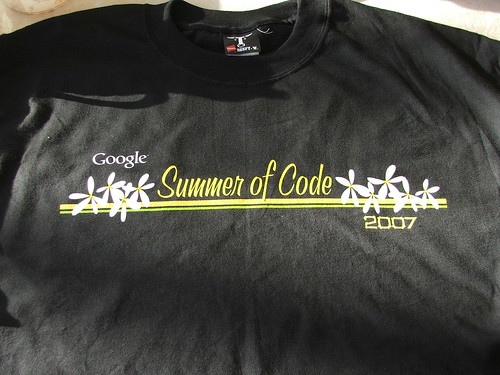
During the 2008 program, we had more than 975 students successfully complete their projects. Each participant received a $4,500 stipend and an ultra-awesome t-shirt to go along with their newly honed programming skills. We're particularly excited by the social ties our students form through the course of the program, as well. We've connected people in more than 98 countries, and hope to bring people from even more places into the Google Summer of Code community this year.

We'll be accepting student applications through April 3, 2009 at 12:00 pm PST. If you're interested in learning more, check out our Frequently Asked Questions or subscribe to our discussion list. You can also check out the Google Open Source Blog for regular updates on the program. When you're ready to get started, visit the Google Summer of Code 2009 site to submit your application. Best of luck to all of our applicants!

For an overview of the program, check out this video.


Selasa, 23 September 2008

The first Android-powered phone

Today, T-Mobile announced the world's first Android-powered phone. This marks an important milestone in the young history of Android. It was less than a year ago, on November 5, that the Open Handset Alliance, a group of more than 30 technology and mobile companies, announced plans to create a complete mobile platform that would facilitate the development of advanced mobile applications and give users the best the web has to offer on a mobile device.

Software developers are key to driving innovation on the web, and also for mobile. That's why, over the past year, we've released several early versions of the Software Developer Kit (SDK) and worked with developers from around the world to make it better and more complete. This has culminated in today's release of the Android 1.0 SDK R1. Through the SDK, developers have unprecedented access to the hardware and software capabilities of the device, enabling them to innovate freely. More than 1,700 applications were developed as part of the Android Developer Challenge. Google engineers have also been busy developing Android applications. Many of our products (Search, Gmail, and Maps, among others) are available on a wide range of phones such as the iPhone, BlackBerry, Windows Mobile devices, and many more. Today, they're also available on Android, and you can check out the Google Mobile blog for more details.

But there's more to the Android story. Not only does it allow all applications open access to the phone's functionality; the platform itself will also be open. The Open Handset Alliance has announced its intention to open source the entire Android platform by the end of the year. Along with the other members of the Alliance, we hope that Android can provide a meaningful contribution to all players in the mobile ecosystem: the developers, the wireless carriers, the handset manufacturers, etc. Everyone will be free to adopt and adapt the technology as they see fit. By doing so, we hope that users will get better, more capable phones with powerful web browsers and access to a rich catalogue of innovative mobile applications.

Developers will soon be able to distribute their applications to real handsets through the beta version of Android Market. Handset manufacturers and wireless carriers will be able to incorporate Android innovations into their own new handsets and service offerings. And users will get better handsets and more choice. We think it's another step towards realizing the full potential of the mobile phone.

Kamis, 17 Juli 2008

Celebrating young computer scientists

Last week, the ten grand prize winners for the first Google Highly Open Participation Contest, our initiative to get pre-university students involved in open source development. We were very excited to welcome these burgeoning computer scientists and their families to Silicon Valley in a celebration of their many accomplishments.


Our grand prize winners and the Open Source team

Chosen from more than 350 students worldwide, our winners created software, documentation and marketing materials for ten different open source projects, getting all this work accomplished in just over two months. For more details, including interviews with the winners and their mentors, check out the Google Open Source Blog.

Selasa, 25 Maret 2008

OpenSocial continues to grow: Welcome, Yahoo!


Last November, OpenSocial was created to help build infrastructure for the social web. OpenSocial provides a common mechanism for developers to easily hook into many different social networks and extend their functionality. Sites including MySpace and orkut have begun to provide OpenSocial applications to their users, and hi5 will be rolling out next week.

Today we're pleased that Yahoo! has announced its support for OpenSocial. We're looking forward to having Yahoo! users join the hundreds of millions of people who will soon enjoy OpenSocial applications. This addition means even more distribution for developers, encourages participation by even more websites, and, most importantly, results in more features for users all across the web.

In addition, Yahoo!, MySpace, and Google are joining with the broader community to create a non-profit foundation to foster the continued open development of OpenSocial. To that end, we've also launched OpenSocial.org, designed to become the main documentation hub and primary source of information about OpenSocial. To learn more, and to get involved, please review the foundation proposal.

With that, welcome, Yahoo! We look forward to growing the social web together.

Senin, 03 Maret 2008

Summer of Code is back!


Google Summer of Code, our program to introduce students to open source software development is coming back. In the past three years, we've seen more than 1500 students 'graduate' from this program, working with 2000+ mentors across 90 countries to produce millions of lines of code. We're pleased to have funded more than $10M in open source development through Summer of Code, and we've increased our funding for it this year by another $1M.

Last year alone, more than 800 students successfully completed their projects. Each received $4500 as a stipend and an awesome T-shirt. We're looking forward to welcoming even more student participants and open source projects into the Google Summer of Code community this year.

We're accepting applications from open source projects who'd like to act as mentoring organizations through March 13th, and will begin taking student applications on March 24th. If you're interested in learning more, just subscribe to the program discussion list. We hope to see you there!

Selasa, 12 Februari 2008

New Open Source Programs blog


Since its inception in 2005, our Open Source Programs Office has been responsible for maintaining license compliance within Google. And over the past three years, our mission has grown encompass even more activities that we hope are useful to our colleagues in the open source community: project hosting, releasing Google created code and funding open source development. We've also continued to get students involved in open source, recently debuting the Google Highly Open Participation Contest for secondary schoolers as a complement to our university program, Google Summer of Code.

When you have this much good news to share, you just have to create your own blog --so we did. Come check out the new Google Open Source Blog for regular updates on all of the above and, if you like what you see, subscribe.